Okay. After thinking about the swing trading setups vs. the daytrading setups, I am beginning to see that they are indeed similar to each other. It took a bit of studying various charts in the 5/10/15/30min and daily/weekly timeframes to convince myself of this. That amount of time spent studying charts has also led me characterize, categorize and summarize the high probability setups that I am looking for when entering a swing trade. Coming from a software Engineering background, I have been working with design patterns in my software design tasks. Design problems repeat themselves, so the solutions should also repeat themselves. It's pretty neat to see that I can re-use a tried, tested and proven design strategy that solves a specific problem, each time this problem occurs. It's like having all these tools in the toolbox at your disposal. Similarly, that is what I will try to do in cataloging the different types of high-probability setups.
The U-Turn Reversal - this is a general reversal pattern coined by TraderX. . This is where the price is currently declining, posts one or more inside candlesticks (doesn't have to be narrow range, just smaller than the most recent red stick), and then reverses back up. On a chart it would look like a U or V shape (not necessarily symmetrical). Entry would be on a break above a clear resistance level. Examples here, here, and here.
The dummy Spot - the term "dummy Trading" was coined by MaoXian. The classic dummy spot is the narrow range, low-volume inside bar whose break allows you to enter in the direction of the prevailing trend. A good example is found here.
The Hammer Reversal - this is a specific reversal pattern, which TraderX described as his "bread and butter" setup. In this pattern, there is a pullback to a retracement zone of sorts (with an optional move back above the retracement zone), and it ultimately leads to a hammer (it usually has a tail/lower wick twice as long as the real body (open-close), and it better for it to be green (close greater than open) with little to no upper wick). Any close above the hammer will be a low risk long. Examples here, here, here, here, and here.
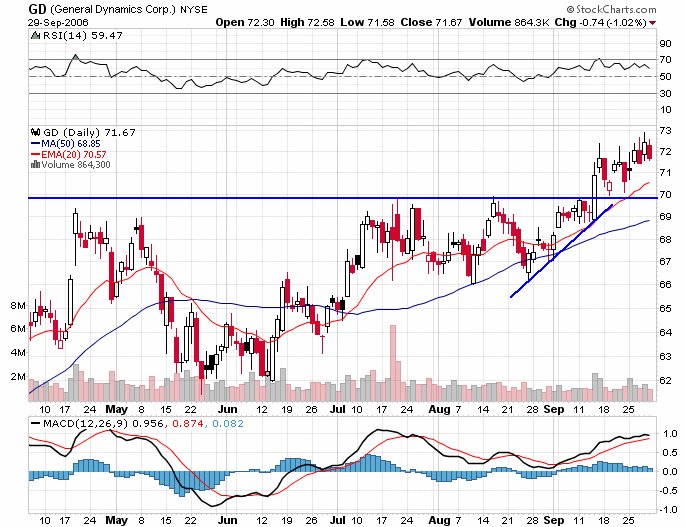
Breakout - This is a simple pattern - there is a clear break above a clear resistance level. The higher the volume on the breakout, the more reliable the pattern. Initial stop would be placed at just below resistance, but moved up as soon as practical. Example here: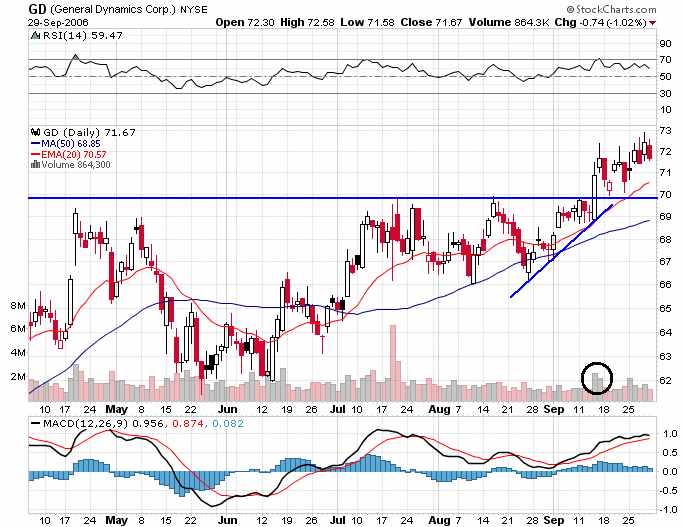
Saturday, September 30, 2006
Cataloging the high probability chart patterns


Thursday, September 28, 2006
Setups: Criteria
In another freebie article, Dan "The Man" Fitzpatrick describes the 3 elements of a successful trading plan. From my opinion, it is more of a checklist of criteria for what stocks to trade. It is not only good to review that, but at the same time, now is as good a time as any to record a documented trading plan.
1. Profit potential. This is not the same as profit target. Many traders define their profit targets in terms of R. So a risk-reward ratio of 3:1 would be equivalent to 3R, or 3 x the amount at risk. However, Dan says to also look at profit potential, which looks at the potential for a stock to move up to the next resistance level. This is pretty significant, because you can manipulate your R's to always get a 3R profit target, but there's less subjectivity about a stock's resistance level.
So, not only should a potential of a 3xR profit be considered, but also the potential of hitting the next resistance level should be considered.
2. Always Set your stop just below the nearest established support level. Never move this stop loss point unless the stock breaks above the nearest established resistance level. Never add to this position unless the stock breaks above the nearest established resistance level.
3. Consider the stock's sector and industry group. Oil stocks will move in the same direction as $XOI, gold stocks will move in the same direction as GDX, semi stocks will move in the same direction as $SOX. It is alway better and less risk to select stocks that are moving with its sector. If you find a stock that is moving in opposite direction to the sector, make sure you have a good understand why you want to make the trade.
4. If you can't find any stocks that meet the above criteria, then there is no trade to be made.
Need better setups
Today's trading went so-so. On the surface, I didn't think that I was breaking any of my rules.
I stuck to my stop rules. However, I am finding that the trades that I select are not of good quality. After the market closed, I reviewed some of the trades that I made today, like NITE for instance. I should have waited until NITE broke above 18.4 before taking a position.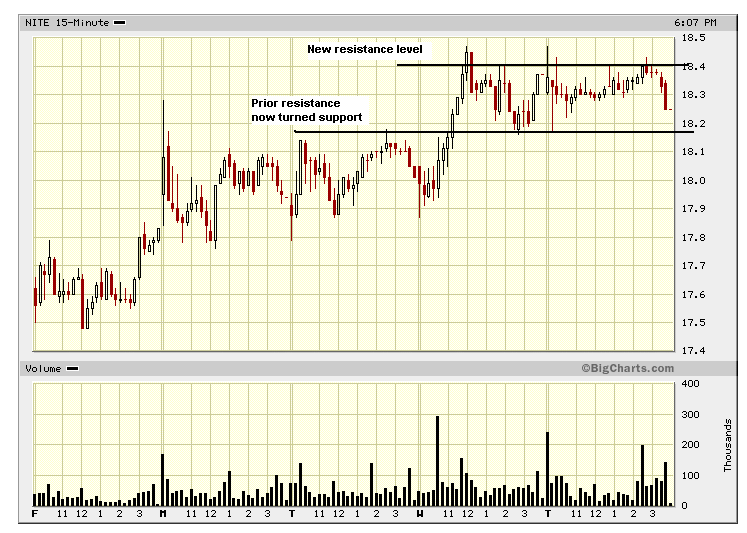
Likewise for GNBT, I should have waited until broke above 1.84 before adding to my position. So, in a way, I was breaking rule #4, which says don't make a trade unless there is a good setup.
So, it is back to more chart reading for me.
Wednesday, September 27, 2006
The Journey of a Thousand Miles
Today was a good day for me. First off, I protected my profits in IAAC. Nailed the exit almost at the top, couldn't have timed it any better than that. Having nailed a victory like IAAC today gives me hope that I can cut down on my other mistakes. I'm sure it's been there before, but lately I've started noticing that I have pre-conceived subconscious notions about which position to sell, and which position to hold onto. This probably explains why I haven't been obeying every one of my stops every time. Perhaps once an alert goes off, I should just dump it instead of looking at the chart. I mean, the whole point of using an alert instead of exposing a hard stop for all to see was to avoid getting whipsawed out of a position, like what happened to XMSR today:
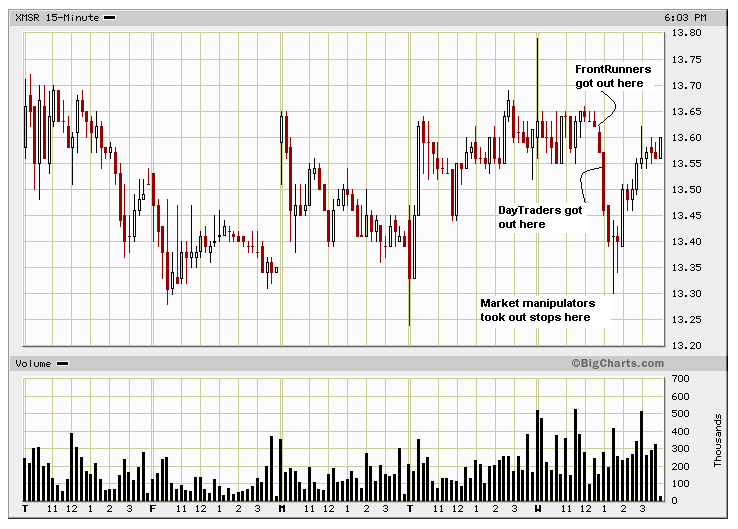
Without a doubt this is a cruel and twisted game that is being played here. An ounce of prevention is worth a pound of cure, so in this case, I would avoid playing XMSR altogether - since now that it's proven it's more than capable of taking out your stops before heading higher, why expose yourself to that kind of whipsaw? There are plenty of other fish in calmer, more well behaved waters to choose from.
Still not sure about when to use alerts, and when to place hard stops (other than the 5minute rule). This is probably one of those case where intuition plays a factor in the criteria.
Even though I did well today, I still have so much to improve upon. The first one would be wiping out my pre-conceived notions. Stops are there for a reason, and I need to stick to them like moths to a light bulb. Another area to improve upon is to practice patience. Waiting for the market to tell you what it is doing, that is so important that it basically defines the difference between success and failure. Van Tharp said successful trading is 60% self-control. Well, to extend that thought a bit further, I would characterize successful trading as:
20% market/sector/chart analysis
20% risk analysis / money management
20% Patience (this is part regarding the waiting for the market to tell you what it is doing)
20% Emotional control (emotionally detachment and objectivity about your trade)
20% Discipline (acceptance, hard work, working hard, persistence and willpower)
I haven't even begun to address emotional control and discipline, I'm still working on the money management and Patience part - but it's a first step, and I remain committed to the goal of becoming a successful trader.
Tuesday, September 26, 2006
Swing Trading vs. Day Trading
On a functional level, Swing Trading is different from Day Trading. Day Traders usually do not hold any positions overnight, whereas Swing Traders typically hold positions anywhere from 2 days to 2 weeks (sometimes even more). Day Traders trade on an intra-day time frame. In other words, they rely mainly on a 2/5/10/15/30-minute chart, whereas Swing Traders trade on a daily time frame, and rely more on an hourly/daily/weekly chart.
However, is the general approach to Swing Trading applicable to Day Trading, and vice versa? In other words, can a successful Swing Trader become a successful Day Trader (without learning/unlearning certain skills/tools/mindset) and vice versa? I've read a few blogs where the person used to be a swing Trader, but decided to make the jump to become a day trader. Based on what I've read, the learning curve in making the transition from a Swing Trader to a Day trader does not seem to be steep. However, I haven't come across anyone who talks about making the transition from day trader to being a swing Trader. So at least in that sense, one difference would be that making the transition from being a Swing Trader to being a day trader is seen as an evolution, a "next step" if you will, but going the other way is never heard of nor talked about.
I've also noticed in a couple of the blogs that I've read, the day trader is looking for a certain setup consisting of narrow range candlesticks. Well, for the Swing Trader, that kind of setup does not occur often on the daily chart, and even less so on the weekly (unless you are talking about a company that has just been bought out). So, to generalize, in my opinion, the patterns and setups that a day trader looks for may not be the ideal patterns and setups for Swing Trading.
The Rules of the Game
Well, today, I almost followed all of my rules.
I set my alerts for BEBE, and when it went off, I exited my position.
For PCLN, I was actually watching it drop from 36.4 down to 36 at the time, and suddenly saw huge blocks appear on the ask when it hit around 35.95. Well, that was enough of a warning for me, and soon after I sold, it dropped as low as 35.55. After that I never watched it, although I should have - had I continued watching it, I would have tried to get back in on the higher low.
The one time I didn't follow my rules was in the case of HANS. Not sure why my brain froze when I saw it drop below 35 early in the morning. It never even made it back above 35. When I realized that I just froze up, it was right after my PHM purchase, so I decided to shut it down for the day at that point.
Probably the maximum open positions that I should have at this point is 4, at least until I have a bit of a track record of making fewer mistakes.
IAAC, part Deux
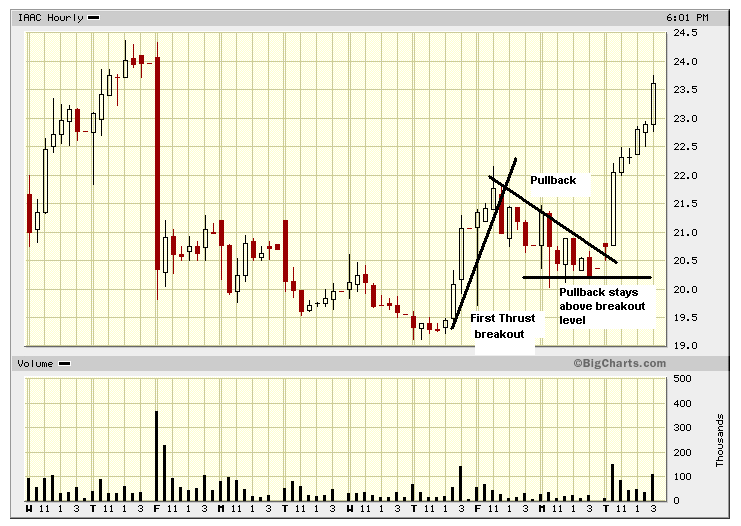
Well, after getting whipped around by IAAC last week, I caught it on the right side of the trade today. This was one of those "first thrust, pullback" type of trade that Dave Landry speaks about so often. Last Thurs/early Fri. morning was the first thrust, then the pullback for the rest of Fri. afternoon. The important thing was that this pullback did not violate the first thrust breakout, and today just happened to be the day that it finished pulling back and started the second thrust.
For me it was a case of being at the right place at the right time.
Chances are good that the downdraft from last last friday will tagged - but then what happens after that? Double top, or break above ? Don't know, but I've moved my stop up to protect my profits.
Thoughts on Swing
In my profile, I've stated that I want to make money by swing trading. The reason that I want to swing trade is because at this point in my life, I am not yet ready to make the transition to trading for a Living. There, I said it! I'm not trading for a living, but I have spent a lot of my time recently reading about the different positive and negative aspects of pursuing this as my new "career." I actually have some seeds of fear, uncertainty and doubt planted in my head that needs to be removed if I am ever to be successful at trading for a living. Starting this journal was one of my strategy for attacking that FUD.
Anyways, given the limited time I have to commit to this, I feel swing trading offers more flexibility and gives me a more reasonable chance of success. Unfortunately, I have been reading a few daytrading blogs lately, and as interesting as they have been to read, I don't think they have improved my swing trading tactics and strategies. Also, I haven't come across any good articles on swing trading (other than Dan Fitzpatrick's freebies offered on theStreet.com). Perhaps I will have to bite the bullet and purchase some more books that have been recommended by other traders that I follow.
My Trader's Manifesto
I've been investing for 6 years now, and it's been an expensive lesson. At first I was a very enthusiastic advocate of researching the fundamentals of a company, and buying on the fundamentals. I used to write some great articles about a company named JDSU, and discussed how great their fundamentals were, and how great their market was. But that approach only led to below average results.
Then I turned to the technical analysis approach. I started learning about many of the TA indicators, beginning with the exponential moving average, then onto more complicated indicators like stochastics and Williams %R. I also dabbled in some Elliot Wave Theory, and went to the clearstation website. Still, I was not having too much success with TA. So I changed my approach again, although I am still sticking with TA for the underlying mechanics.
For me, the hardest part about making money with stocks was learning how to sell. At first I would buy on the TA signals, but when the purchase went into the red, for some inexplicable reason, I could not bring myself to sell the stock. I would hold onto the stock because I thought the fundamentals were great. No really, I literally thought, "I'll buy this stock, and if the trade doesn't work out, I'll hold it because the company behind the stock is a great company." When a purchase I made turned from green into red, I went from feelings of victory to feelings of defeat. What an emotional rollercoaster !
So now, I have forced myself to learn how to sell. This has led me to my own trader's manifesto:
1) Capital Preservation supersedes maximizing capital gains.
In other words, fear is more important than greed. Although fear prevents the maximization of profit, greed promotes the maximization of loss, and is therefore, more damaging. This is a hard lesson to learn, because many times, you want to keep holding a stock on the hopes that it will rebound. Also, many times, I want to hold because the greedy side of me sees visions of a multi-bagger potential in the stock. Greed drives me to hope for the turnaround, hope for the home run. Because of that, many times I have overlooked the fact that the pain of losing money on a trade is a far greater pain than the pain of not buying a stock and then watching it run away from you. That is the real key to this point - Capital preservation seeks to minimize the pain of losing money on a trade. Attempting to avoid the pain of taking a small loss early on causes me to make more mistakes, like holding it too long, or doubling down on a losing position, which leads to greater pain of dealing with potentially bigger losses.
2) Pride must submit to making money as a trader.
In more ways than one, my own pride and ego is in conflict with the notion of making money on a stock. Who wouldn't want a perfect track record in their trades? Who doesn't want to be known as the trading guru whom others turn to for trading advice? Who doesn't want to be known as the one who correctly called the top or the bottom on a stock/sector/market? So I kept holding on to a losing trade because I wanted to be right every time, I could not bring myself to admit that I would not be the trading guru that everyone admires. Least of all, I did not want to admit that I was wrong on that trade. But that is the one single thing that every trader must come to terms with if he/she wishes to continue on the path towards becoming a successful trader. There simply isn't any other way around cutting my losses and moving on. As long as I didn't learn this lesson, I could not make progress towards become a successful trader.
3) There is only one hat to wear - the trader's hat.
Warren Buffet's mindset of equating the purchase of a company's stock to being a part owner in a company is a romantic notion which has its own place in the investment world, and has its use, but mix FA and TA into a trade is a dangerous game to play. Back in 2000, JDSU, PMCS, NT, AOL, KIDE and CMGI were all great companies with great fundamentals, and great growth stories, but that sure as heck did not prevent all of their stocks from diving off a cliff. If I invest in a company's stock because of the great FA, and plan to hold it 5 years and actually follow through with that plan, then that's one thing, but then don't question a trade you made "....because it had great fundamentals." You trade stocks based on the technicals, and invest in a company based on the fundamentals. The key is in knowing the difference between the two.
4) Elminate all the other emotions before, and after entering a trade.
Greed, hope, and love are three of the worst emotions that can quickly destroy a successful trade. When a trade goes in your favour and you've already made a handsome profit, it's time to reduce your exposure in that trade (by locking in some profits), or time to bump up your stop loss level. It's certainly not the time to continue to hold and do nothing in the hopes of making that home run windfall that will strike you rich instantly. Nor is it the time to hold because you just fell in love with the company/stock. Anger, greed, hope, love are all the kinds of emotions which can cloud your judgement and reduce your ability to make pragmatic, objective trading decisions.
By keeping your emotions in check, and remaining objective at all times, you'll be able to make intelligent trading decisions and avoid making rash trading decisions out of love, anger, greed, hope.
5) Practice Patience and discipline.
This is still a work in progress for me, especially the patience part. There is nothing to be gained by making a trade just because you haven't done any all week. And it can even be dangerous to enter a trade without waiting for it to meet your criteria. When you make a trade because a stock a stock has met your criteria, that means it has proven itself to you, it IS showing you what it is doing, and that's when it is the right time to enter. Waiting for confirmation of a top/bottom, or waiting for those very good trading patterns or "set-ups" to come to you instead of chasing after them will reduce the risk in entering a trade. Act upon them in a prudent and pragmatic way when the "set-up" or criteria is met, and don't second guess yourself. The market will do what the market wants to do, and nobody can force the market's hand.
6) Plan your trade, and trade to your plan.
At first, I didn't know what this advice meant. I plan to make money on my trades, so what's the problem ?? The key is that you need to have a detailed plan about how you will trade the stock even before entering the trade. If it goes down, but doesn't hit your stop loss, what will you do? If it goes up, what will you do? Know how much equity you are putting at risk before even making the trade. In other words, it's not the size of the trade that matters, but the percentage amount at RISK that matters. This is such an important point, that I would say my failure to fully comprehend what it really meant caused my many mistakes in the past 2 years of trading. One trader advocates setting up certain rules which provide a framework for trading. He also explains risk/reward pretty well in this article. The gist of it is that I should always know what percentage of my total equity is at risk in any given trade. The difference between the stop loss point and the entry price represents the amount of risk on a given trade. As a general rule, I should risk only 1%-2% of my total equity on any given trade. I still don't follow this consistently, but I understand where I need to improve so that I can get the results that I want.
7) You MUST make the Trend your friend
Don't fight the trend, don't fight the tape. I've heard this advice mentioned many times, and this is my perspective on that sage advice. In the absence of any news affecting the stock, the overall market trend and sector trend are the two biggest influences on that given stock. Unless you are very sure of what you are doing or have intimate knowledge about the stock's price pattern, buying a stock when its index/market is trending down, or shorting a stock when its sector/market is trending up is just inviting more unecessary risk. When looking at a potential trade, never lose sight of what the stock's competitors, overall sector, and overall market is doing. The market has proven time and time again that it can stay wrong and/or irrational longer than you can stay solvent. So, not only does this mean that the market is always right, but regardless whether you love or hate the market or sector, you MUST make it your friend, because your survival depends on it.
8) Understand how to use Time Frames
Looking at the daily candlestick chart provides a short term perspective on the stock's trend. However, looking at the weekly, or even monthly candlestick chart for that same stock can and often does reveal a completely different perspective on that stock.
Always start with looking at the weekly chart before looking at the daily chart for a stock. This is very important because it gives you insight into where the largest forces of supply and demand are. Are they just beginning a bullish trend, or are they nearing a top? Once you have this bigger picture view, it will help to give you confidence in any other decisions you may decide to make on the stock in question.
Longer term time frames always have precedence over shorter term time frames. For example, say that the monthly MACD is showing a bullish crossover, but at the same time the daily MACD is showing near term selling pressure. Even though the shorter term outlook is bearish, in the back of your mind you should be thinking that the stock is still modestly bullish and at the worst case will enter into a basing pattern before eventually turning higher to start a new up trend.
9) Be at Peace with Letting Go
This point actually ties together points #2 and #7. Hoping for the turnaround, or not being able to admit to your mistake consumes energy, and causes you to dwell in the same undesirable place. To me, selling when a stock hits your stop loss represents the fact that either you made a mistake on your trade, or that your trade criteria for entering/exiting a trade turns out to be wrong. Once you attain ability to accept the fact that you made a mistake, or that your criteria was wrong, you can then free up your energy to search on the next trading plan. It's actually refreshing to be able to move on, and put those mistakes/wrongs behind you, instead of having to fight with them constantly because of your pride. This is analogous to the new age spiritual mindset of surrounding yourself with positives in your life.
 NetVibes Me!
 BlogLine This!
 FeedBurner This!